---
title: "Queen of To Do's Dreambox Craft Dupe: Under $1000 DIY Solution!"
description: Queen of To Do founder Kate Ginsberg wanted a Dreambox storage system but not the $2,500 price tag. So she built her own using IKEA PAX cabinets, a few items from Lowe's, and some basic tools. Full materials list and step-by-step instructions inside.
image: https://www.queenoftodo.com/hubfs/Before%20and%20After%20Dreambox%20Dupe.png
---
[Skip to content](https://www.queenoftodo.com/blog/dreamy-dreambox#main-content)
[.png?width=1200&height=400&name=Untitled%20design%20(28).png)](https://www.queenoftodo.com)
- [Plans](https://www.queenoftodo.com/plans)
- [Services](https://www.queenoftodo.com/household-support)
Show submenu for Services
- [Comprehensive Services Lists](https://www.queenoftodo.com/total-lifestyle-management-discover-our-extensive-concierge-services)
- [Home Manual](https://www.queenoftodo.com/manual)
- [Household Support](https://www.queenoftodo.com/household-support)
- [Laundry](https://www.queenoftodo.com/laundry)
- [Errands](https://www.queenoftodo.com/errands)
- [Relocation Concierge](https://www.queenoftodo.com/relocation)
- [Holiday](https://www.queenoftodo.com/holiday-decor)
- [FAQ](https://www.queenoftodo.com/faq)
- [Our Company](https://www.queenoftodo.com/about)
Show submenu for Our Company
- [About Us](https://www.queenoftodo.com/about)
- [Core Values](https://www.queenoftodo.com/values)
- [Franchise Opportunities](https://www.queenoftodo.com/franchise)
- [Referral Program](https://www.queenoftodo.com/queen-of-to-dos-referral-program)
- [Book Kate as a Speaker](https://www.queenoftodo.com/book-kate-ginsberg-inspiring-keynotes-on-empowerment-balance)
- [Client Case Studies](https://www.queenoftodo.com/clients)
- [Blog](https://www.queenoftodo.com/blog)
- [Podcast](https://www.queenoftodo.com/podcast)
Open main navigation
Close main navigation
- [Plans](https://www.queenoftodo.com/plans)
- [Services](https://www.queenoftodo.com/household-support)
Show submenu for Services
- [Comprehensive Services Lists](https://www.queenoftodo.com/total-lifestyle-management-discover-our-extensive-concierge-services)
- [Home Manual](https://www.queenoftodo.com/manual)
- [Household Support](https://www.queenoftodo.com/household-support)
- [Laundry](https://www.queenoftodo.com/laundry)
- [Errands](https://www.queenoftodo.com/errands)
- [Relocation Concierge](https://www.queenoftodo.com/relocation)
- [Holiday](https://www.queenoftodo.com/holiday-decor)
- [FAQ](https://www.queenoftodo.com/faq)
- [Our Company](https://www.queenoftodo.com/about)
Show submenu for Our Company
- [About Us](https://www.queenoftodo.com/about)
- [Core Values](https://www.queenoftodo.com/values)
- [Franchise Opportunities](https://www.queenoftodo.com/franchise)
- [Referral Program](https://www.queenoftodo.com/queen-of-to-dos-referral-program)
- [Book Kate as a Speaker](https://www.queenoftodo.com/book-kate-ginsberg-inspiring-keynotes-on-empowerment-balance)
- [Client Case Studies](https://www.queenoftodo.com/clients)
- [Blog](https://www.queenoftodo.com/blog)
- [Podcast](https://www.queenoftodo.com/podcast)
- [Get started](https://form.typeform.com/to/TR4tC8mx?utm_source=website&utm_medium=header_button&utm_campaign=get_started)
[Get started](https://form.typeform.com/to/TR4tC8mx?utm_source=website&utm_medium=header_button&utm_campaign=get_started)
2/22/23, 2:18 PM
# Queen of To Do's Dreambox Craft Dupe: Under $1000 DIY Solution!
 [Kate Ginsberg](https://www.queenoftodo.com/blog/author/kate-g)
Share: [Share this page on Facebook](http://www.facebook.com/share.php?u=https://www.queenoftodo.com/blog/dreamy-dreambox) [Share this page on Facebook](http://www.linkedin.com/shareArticle?mini=true&url=https://www.queenoftodo.com/blog/dreamy-dreambox) [Share this page on Facebook](http://pinterest.com/pin/create/link/?url=https://www.queenoftodo.com/blog/dreamy-dreambox) [Share this page on Facebook](mailto:?body=https://www.queenoftodo.com/blog/dreamy-dreambox)
*Disclosure: This post contains affiliate links, which means we may receive compensation if you purchase through these links. Rest assured, our product recommendations are based solely on quality and relevance, and the compensation has not influenced our choices.*
---
Kate has wanted a Dreambox for years.
If you're in the crafting world, you know what a Dreambox is: a wall of organized, foldable, beautiful storage for every sewing notions, fabric scrap, and crafting supply you own. You also probably know the price. At over $2,500, it's the kind of thing that sits on a wishlist for a long time.
So Kate did what she does: she figured out how to make it happen anyway.
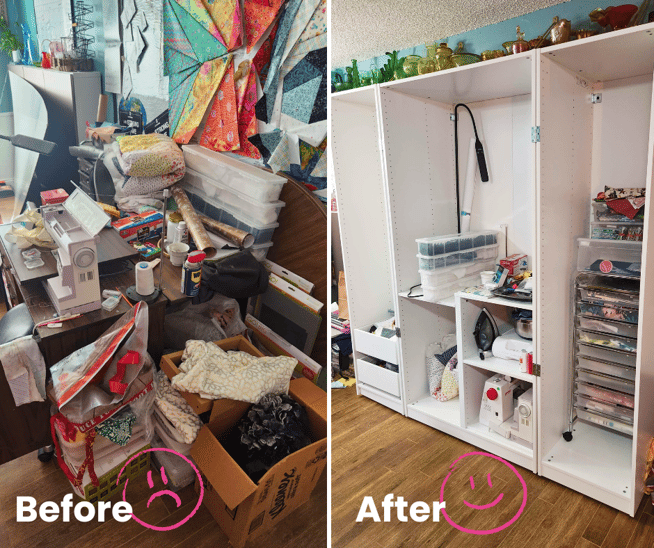
Using IKEA PAX wardrobe frames, a few pieces from Lowe's, and some hardware from Amazon, she built a fully functional Dreambox dupe for under $1,000. It folds out, rolls around, has a built-in worktable, and looks intentional rather than improvised. Basic assembly skills and standard tools are all you need.
Here's everything she used and exactly how she put it together.
---
### Before You Buy Anything
Two things to confirm before you order a single item.
**Check your ceiling height.** The PAX frames need to stand upright during assembly. Measure before you commit to a height.
**Decide on your depth.** IKEA offers PAX frames in two depths: 13.75" and 22.875". You'll need one wide frame (39.325") and two narrow frames (19.625"). The wide and narrow frames can be different depths as long as both narrow frames match each other. Kate went with the deeper option because she knew she'd want the extra storage later.
---
## Materials
Amazon:
- [Wheels (set of 12)](https://amzn.to/3y8w3Ek)
- [Piano hinge (x2)](https://amzn.to/41Dn1Ni)
Lowes:
- [Mortise hinges (x2)](https://www.lowes.com/pd/ReliaBilt-RB-2-1-2-IN-ZN-NARROW-HNGE-2-CT/5001642135)
- [Whiteboard panel](https://www.lowes.com/pd/ReliaBilt-RB-2-1-2-IN-ZN-NARROW-HNGE-2-CT/5001642135)
- 1x4 board (one 10-foot board from any lumber store works, or check the scrap section for shorter pieces at a discount)
- 1.25" to 1.5" wood screws and small washers (Kate had these on hand; the washers keep screw heads from slipping through the wheel bracket slots)
IKEA:
- [PAX wide wardrobe frame](https://www.ikea.com/us/en/p/pax-wardrobe-frame-white-20214566/)
- [PAX narrow wardrobe frame (x2)](https://www.ikea.com/us/en/p/pax-wardrobe-frame-white-70214559/)
- [Komplement divider](https://www.ikea.com/us/en/p/komplement-divider-for-frame-white-60246396/)
- [Komplement drawer (x2)](https://www.ikea.com/us/en/p/komplement-drawer-white-10246308/)
- [Linnmon table top](https://www.ikea.com/us/en/p/linnmon-tabletop-white-00251135/) (x2)
- [Olov legs](https://amzn.to/3kECLij) (x4)
- [Komplement shelves (x4)](https://www.ikea.com/us/en/p/komplement-shelf-white-30277959/)
Add later when the budget allows:
- [Komplement drawers (x8)](https://www.ikea.com/us/en/p/komplement-drawer-white-10246308/)
- [Komplement shelves](https://www.ikea.com/us/en/p/komplement-shelf-white-30277959/) (x4)
## Assembly
Start by assembling the PAX cabinets according to IKEA's instructions. Skip the feet that come with the frames. You're replacing those with wheels.
**Step 1: Prepare the wheel boards.** Cut the 1x4 board into pieces that fit inside the bottom of each cabinet section. You need two pieces per cabinet. Precision isn't critical here. Close is good enough. Use the wheel brackets and a Sharpie to mark placement on the boards, then drill pilot holes before attaching the wheels. This prevents the wood from splitting. Kate eyeballed the spacing.
**Step 2: Attach the wheels.** With your cabinets lying flat, position a prepared board at the bottom edge of each section (long side for the wide cabinet, short edge for the narrow ones) and attach the wheels. Four wheels per cabinet. Screws should be long enough to hold firmly without going all the way through the base. Kate used a mix of braking and non-braking wheels based on what shipped fastest. Either works.
**Step 3: Stand the cabinets up and line them up.** Place them next to each other with the open sides facing you, the wide cabinet in the center flanked by the two narrow ones. They should be level and close to the same height.
**Step 4: Mark and attach the hinges.** Mark hinge placement roughly 12 to 18 inches from the top and 18 to 24 inches from the bottom of each cabinet. If you went with the taller PAX frames, add a third hinge in the middle. Open each hinge and line it up with the interior edge of the cabinet walls to confirm alignment before drilling anything. Drill pilot holes, then attach with the included screws. Test the narrow cabinets in both open and closed positions before moving on.
**Step 5: Add shelves, drawers, and dividers.** Arrange these however suits your materials. This is the entirely personal part. Command hooks, pegboards, rods: anything goes here.
**Step 6: Build the fold-out table.** Kate used the Komplement divider inside the wide PAX unit as an attachment point for one Linnmon tabletop. Hinge placement here matters for how the table opens and closes, so take your time with it. The second tabletop attaches to the first using the long piano hinge along the long sides of both tops.
Install the Olov leg brackets on the tabletop: one on the outer edge near the cabinet and three on the far end. The legs are adjustable in height and unscrew completely for storage when the table folds back in.
**Step 7: Finish the backs.** The backs of the narrow cabinets, which now face into the room when the unit is open, are brown. Kate covered hers with whiteboard panels cut to size and attached with small finishing nails or construction adhesive. You can also paint them, add decorative paneling, or leave them as is. A painted frame or strip of molding around the whiteboard gives it a finished look if you want to take it a step further.
Add whatever handle and latch combination works for your space, and you're done.
---
### A Few Notes from Kate
"I've wanted a Dreambox for sewing and crafting storage for years, but spending over $2,500 on a cabinet was hard to justify. Using PAX cabinet frames, coordinating drawers and shelves, and a few other items from Lowe's and Amazon, I was able to build my dream cabinet for under $1,000 with just basic assembly skills and tools, and you can too."
The total cost will vary depending on which PAX depth you choose and how many drawers and shelves you add. The base build gets you a fully functional cabinet. The additions Kate listed above are for when you're ready to fill it out further.
---
## In Central Texas?
Queen of To Do can handle this project for you from start to finish: picking up materials, assembling the unit, and organizing the inside to match how you actually work. If you're outside of Central Texas, virtual assistant support is available to help you plan and customize the build for your space.
[](https://www.queenoftodo.com/hs/cta/wi/redirect?encryptedPayload=AVxigLJWeTsIs3Hdvpgm4JtIZ2bjgAoUnCUMralNFTfohsojzMmm6sHxbTtU4yxevHa%2BvEGqAgOD1iVLEXfLjvKPIHBBJJOcNiDmpNwS9CNU%2BUTGLYidvJ0vc%2FACVSzF1QTeppbc7qn%2Bm7VPmL494fz6UquCV9bzb4%2B7gyHJTCIeHkJk9iJ7iA3%2FprO1g0fD0gD1koLG9irFSQ0syrjmFqTL0C50jUVgLkmhRRtODqZqTg%3D%3D&webInteractiveContentId=324243525321&portalId=21849568)
[dreambox](https://www.queenoftodo.com/blog/tag/dreambox), [ikea](https://www.queenoftodo.com/blog/tag/ikea), [diy](https://www.queenoftodo.com/blog/tag/diy), [DIY dreambox dupe](https://www.queenoftodo.com/blog/tag/diy-dreambox-dupe), [craft room organization](https://www.queenoftodo.com/blog/tag/craft-room-organization), [Ikea furniture assembly](https://www.queenoftodo.com/blog/tag/ikea-furniture-assembly), [central texas personal assistants](https://www.queenoftodo.com/blog/tag/central-texas-personal-assistants), [custom storage solutions](https://www.queenoftodo.com/blog/tag/custom-storage-solutions), [home organization tips](https://www.queenoftodo.com/blog/tag/home-organization-tips), [Small space organization](https://www.queenoftodo.com/blog/tag/small-space-organization), [product dupe](https://www.queenoftodo.com/blog/tag/product-dupe)
## Related posts
[](https://www.queenoftodo.com/blog/how-personal-assistants-source-custom-organizational-solutions)
[lifestyle concierge](https://www.queenoftodo.com/blog/tag/lifestyle-concierge), [dreambox](https://www.queenoftodo.com/blog/tag/dreambox), [personal assistant services](https://www.queenoftodo.com/blog/tag/personal-assistant-services), [DIY dreambox dupe](https://www.queenoftodo.com/blog/tag/diy-dreambox-dupe), [home organization](https://www.queenoftodo.com/blog/tag/home-organization), [Queen of To Do](https://www.queenoftodo.com/blog/tag/queen-of-to-do), [personal assistant austin](https://www.queenoftodo.com/blog/tag/personal-assistant-austin), [austin home management](https://www.queenoftodo.com/blog/tag/austin-home-management), [custom solutions](https://www.queenoftodo.com/blog/tag/custom-solutions)
## [How Personal Assistants Source Custom Organizational Solutions](https://www.queenoftodo.com/blog/how-personal-assistants-source-custom-organizational-solutions)
 [Queen of To Do](https://www.queenoftodo.com/blog/author/queen-of-to-do)
4/10/26, 8:00 AM
[Read more](https://www.queenoftodo.com/blog/how-personal-assistants-source-custom-organizational-solutions)
[](https://www.queenoftodo.com/blog/start-delegating-today-a-step-by-step-guide-to-lightening-your-load)
[delegation](https://www.queenoftodo.com/blog/tag/delegation), [austin personal assistant](https://www.queenoftodo.com/blog/tag/austin-personal-assistant), [delegating tasks effectively](https://www.queenoftodo.com/blog/tag/delegating-tasks-effectively), [benefits of delegation](https://www.queenoftodo.com/blog/tag/benefits-of-delegation), [how personal assistants help](https://www.queenoftodo.com/blog/tag/how-personal-assistants-help), [Austin lifestyle concierge](https://www.queenoftodo.com/blog/tag/austin-lifestyle-concierge), [Queen of To Do personal assistant services](https://www.queenoftodo.com/blog/tag/queen-of-to-do-personal-assistant-services), [how to lighten your workload](https://www.queenoftodo.com/blog/tag/how-to-lighten-your-workload)
## [Start Delegating Today: A Step-by-Step Guide to Lightening Your Load](https://www.queenoftodo.com/blog/start-delegating-today-a-step-by-step-guide-to-lightening-your-load)
 [Queen of To Do](https://www.queenoftodo.com/blog/author/queen-of-to-do)
12/13/24, 8:59 AM
[Read more](https://www.queenoftodo.com/blog/start-delegating-today-a-step-by-step-guide-to-lightening-your-load)
[](https://www.queenoftodo.com/blog/how-to-tackle-big-projects-without-losing-your-mind)
[home organization](https://www.queenoftodo.com/blog/tag/home-organization), [delegating tasks effectively](https://www.queenoftodo.com/blog/tag/delegating-tasks-effectively), [stress-free lifestyle](https://www.queenoftodo.com/blog/tag/stress-free-lifestyle), [How delegating tasks changed lives](https://www.queenoftodo.com/blog/tag/how-delegating-tasks-changed-lives), [Tackling big projects](https://www.queenoftodo.com/blog/tag/tackling-big-projects), [Breaking down big tasks](https://www.queenoftodo.com/blog/tag/breaking-down-big-tasks), [Pro delegation techniques](https://www.queenoftodo.com/blog/tag/pro-delegation-techniques), [Celebrating milestones](https://www.queenoftodo.com/blog/tag/celebrating-milestones)
## [How to Tackle Big Projects Without Losing Your Mind](https://www.queenoftodo.com/blog/how-to-tackle-big-projects-without-losing-your-mind)
 [Queen of To Do](https://www.queenoftodo.com/blog/author/queen-of-to-do)
12/6/24, 9:00 AM
Taking on a big project can feel overwhelming—whether it’s organizing your home, managing a...
[Read more](https://www.queenoftodo.com/blog/how-to-tackle-big-projects-without-losing-your-mind)
## Home, Handled.
[facebook-f icon](https://www.facebook.com/queenoftodo) [linkedin-in icon](https://www.linkedin.com/company/queen-of-to-do) [instagram icon](https://www.instagram.com/queenoftodo) [envelope icon](mailto:hello@queenoftodo.com) [Follow us on TikTok](https://www.tiktok.com/@queenoftodo) [Subscribe to our podcast](https://open.spotify.com/show/6CgahsuLYt3ZK1VLuuhhjy?si=VNoB-y_mSN-M0cggK604tQ) [Follow us on Facebook](https://www.youtube.com/@queenoftodo) [Follow us on Facebook](https://g.co/kgs/pFBJ5gW)
- [Plans](https://www.queenoftodo.com/plans)
- [Services](https://www.queenoftodo.com/household-support)
- [Our Company](https://www.queenoftodo.com/about)
---
[.png?width=1200&height=400&name=Untitled%20design%20(28).png "Queen of To Do \"Life's hassles, handled.\" logo")](https://www.queenoftodo.com)
Copyright © 2026 Queen of To Do
3801 N Capital of TX Hwy, Ste E240 Unit #3399
Austin, 78746
512.761.7084
[Privacy Policy](https://www.queenoftodo.com/privacy-policy)
```json
{
"@context" : "https://schema.org",
"@type" : "BlogPosting",
"author" : {
"@type" : "Person",
"name" : "Kate Ginsberg",
"url" : "https://www.queenoftodo.com/blog/author/kate-g"
},
"dateModified" : "2026-06-02T22:35:46.613Z",
"datePublished" : "2023-02-22T20:18:52.000Z",
"headline" : "Queen of To Do's Dreambox Craft Dupe: Under $1000 DIY Solution!",
"image" : [ "https://www.queenoftodo.com/hubfs/Before%20and%20After%20Dreambox%20Dupe.png" ],
"mainEntityOfPage" : {
"@id" : "https://www.queenoftodo.com/blog/dreamy-dreambox",
"@type" : "WebPage"
},
"publisher" : {
"@type" : "Organization",
"logo" : {
"@type" : "ImageObject",
"url" : "https://www.queenoftodo.com/hubfs/Untitled%20design%20(28).png"
},
"name" : "Queen of To Do"
}
}
```
```json
{
"@context" : "https://schema.org",
"@type" : "BlogPosting",
"author" : {
"@type" : "Organization",
"name" : "Queen of To Do",
"url" : "https://www.queenoftodo.com/"
},
"dateModified" : "2024-10-15",
"datePublished" : "2023-02-22",
"description" : "Want a dazzling Dreambox craft storage system without the $2500+ cost? Try this DIY dupe where everything comes from Ikea, Amazon, and a hardware store and is under $1000.",
"headline" : "Dreamy Dreambox Craft Dupe (for under $1000!)",
"image" : "https://21849568.fs1.hubspotusercontent-na1.net/hubfs/21849568/Dreamy%20Dreambox%20Dupe.png",
"mainEntityOfPage" : {
"@id" : "https://www.queenoftodo.com/blog/dreamy-dreambox",
"@type" : "WebPage"
},
"publisher" : {
"@type" : "Organization",
"logo" : {
"@type" : "ImageObject",
"url" : "https://queenoftodo.com/hubfs/Queen%20of%20To%20Do%20personal%20assistants%20logo.png"
},
"name" : "Queen of To Do"
}
}
```